Stacking Dice
Assessment is tricky. As teachers, assessment serves many purposes.
But how do students view assessment? Do they see it as an opportunity to show what they know? Is it a snapshot in time with room for growth and development? Is assessment just a number or letter on a page? Do students know what these letters and numbers mean? Are these results an end point or are they a call to action? Do assessments affirm what students believe their skills and knowledge to be? Are they a cause of anxiety or a reason to celebrate?
I have worked really hard to talk to students about growth mindset and learning goals. I have mapped out paths from students’ current understanding to our learning target. Communicating where students are expected to be at any given time in our learning, what comes next, and what might be done to advance has always been a focus. I have explained rubrics, our outcome based grading system, and the processes used so that the most current performance is what their grades describe. Eventually I have been somewhat successful in guiding students to use their descriptive feedback to improve their work and direct their independent practice, but it has been a struggle.
Oh how I wish I had seen this lesson while I was still a classroom teacher. This lesson made so many things so accessible and so relatable to students. What a rubric is, how we use it, why we use it, and what we do next. The lesson described below was created by Liam O’Brien of John Martin Junior High in Dartmouth, Nova Scotia. If you have yet to speak to your students about rubrics, assessment and evaluation, or feel that your efforts to date did not quite land – this could be the lesson for you!
This lesson could have been about persistence, risk taking, and grit. Perhaps the power of self reflection. It could have been about the simple joy of learning new things even if we are “never going to need this skill in real-life”. It could have been an opening to share our own unique skills or unusual tricks that set us apart. These are all possibilities I thought about when I stumbled into this amazing lesson. I had been meeting with another teacher, so I slipped into Mr O’Biren’s class a few minutes late to a lesson already in progress. A YouTube video was playing and students were totally riveted. On screen I watched the progress of a guy, who I later found out was Mike Boyd, trying to scoop dice with a cup and stack them in a tall tower. We all laughed and sympathized as he failed miserably. He got frustrated. He failed. He tried again, and failed again. A timer tracked showed how long he had been engaged in this enterprise. This must be about persistence I thought. As the video continued, we watched Mike pause to consider materials, analyze his mistakes, and brainstorm solutions. Ohhhhh I see! This lesson must be about self reflection! He pressed on, as determined as before, celebrating every small victory that got him closer to his goal. That’s it! This lesson is about breaking a learning goal into smaller manageable pieces, and celebrating the wins along the path to success . . . right?
If you saw this video playing in a classroom, what would you think the intended message is?
As a classroom teacher, I had a few lessons that I used every single year. Activities perfected over time that set the tone. I had activities to promote and practice group work and ones that value persistence. I had tasks that allow us to reflect on our math journeys and ones to activate prior knowledge. We got to know each other as people and as math-ers. These lessons are chosen and developed so carefully. These lessons matter.
In my current role as a math coach and support teacher, it is so interesting to see the lessons that other teachers choose to establish their classroom communities. This one, the stacking dice lesson, should definitely make the cut.
Here is how I remember it . . .
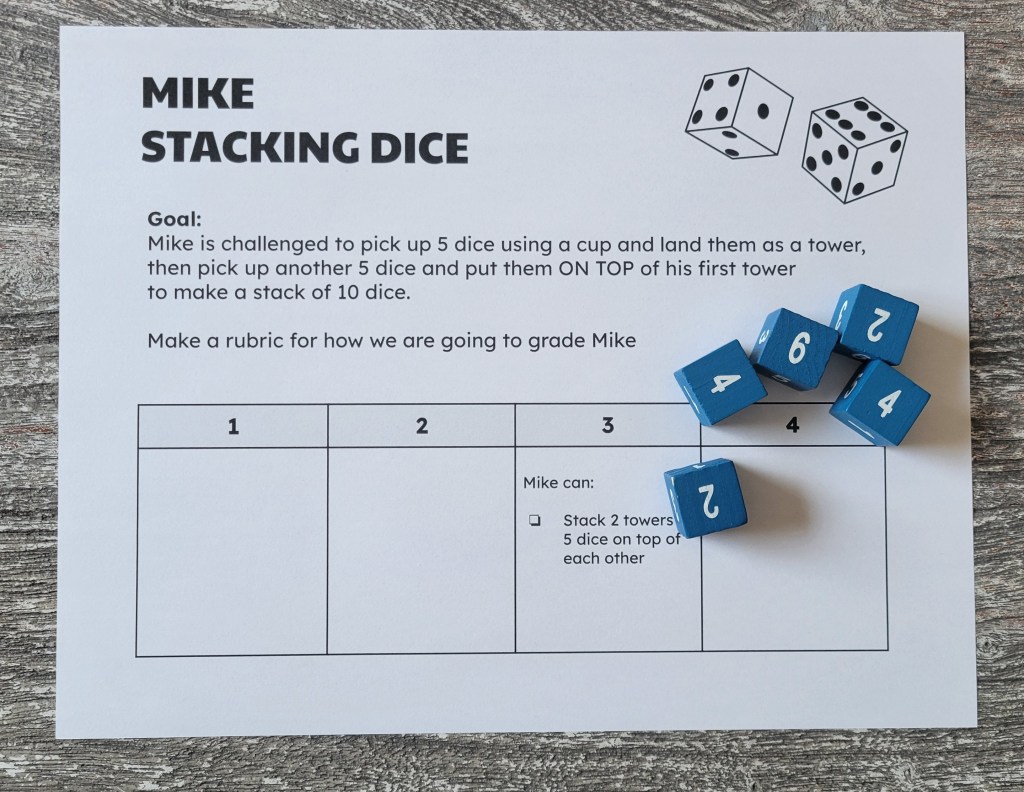
Students viewed the beginning of the video. In it, Mike Boyd shares a challenge given to him: Scoop dice from a table using a cup, and stack them in a tower of 5 dice. Do this twice so that the second tower stacks on top of the first to create a total stack of 10 dice.
Next students were encouraged to brainstorm how Mike would do. What would his initial signs of progress be? Two dice stacked nicely? Three? The first tower of five dice? As students debated what meaningful progress looked like in this scenario, Mr O’Brien displayed an empty table with four columns. A 1-4 rubric, much like the rubric used to gauge student achievement with learning outcomes. He asked again what the learning goal was…what skill did Mike need to do to be considered successful? Scoop dice from a table using a cup and stack two towers of 5 dice on top of each other. That skill went in the third column – since it is this column that indicates that the learning outcome has been met. He encouraged students again to think about what a “1” might be, and what progress might be awarded a “2”. Students were given their own blank rubric to record their ideas. We discussed using positive language and stating what Mike could do instead of what mistakes he made. That is, instead of saying he dropped 3-4 dice, students wrote “Mike can stack one tower of 5 dice”. Students decided that to get a 4, Mike needed to be able to do his stacks of 10 dice consistently and could extend beyond the challenge doing other tricks with ease and confidence.
I was beginning to see the intended message of this lesson.
This lesson was about understanding assessment, valuing the journey, celebrating meaningful progress, and continuing to strive for betterment beyond the original target. This lesson was about understanding and valuing a rubric and using it to assess and direct future learning. This lesson strived to build learning partners. Yup – I was pretty excited for what came next.
Once students had their rubrics created, the video continued. At key moments, the video was paused. Students were invited to consider Mike’s current skill set and assess him using their rubric. Debate and conversation ensued.
We watched a little more, then another pause. Where was he now?
This process of observing and evaluating Mike’s progress continued until all of a sudden – success!
After much frustration, self reflection, changes in materials, seating and perspective, and hours and hours of focused painstaking practice – Mike did it! He stacked two towers of five dice successfully! The class was as excited as he was – totally invested in his journey. But he didn’t stop there. He happily extended beyond his original goal, challenging himself to additional tricks which gave us the opportunity to discuss and award the elusive “4” in our rubric.
I thought this lesson was perfect.
It was an engaging scenario with a hero to root for. It invited conversation and debate and different perspectives could be defended. It mirrored and made accessible our outcome based grading system, showcasing for students that there are signposts along the road to our learning goal that can be celebrated even though our end goal has yet to be achieved. It demonstrated that frustration is normal, persistence pays off, and self reflection can allow for meaningful adjustments. Pure gold.
In the days and weeks to follow, this lesson was a shared experience that was returned to often. With divisibility being our first topic of the year, students were presented with a rubric created in student friendly language. Conversations returned to Mike and the dice to clarify that yes – we know how to determine if a number is divisible by 2, 5, and 10, and that is wonderful, but this is still just the start of our work on divisibility so we are in the 1 zone of our rubric. And yay! We just showed with our exit ticket that we can identify numbers divisible by 3 and 9 – look at that! We are moving through the 2 zone in our rubric. It now made sense to students that small quick check-ins were to measure, confirm, and celebrate progress, but were not necessarily something that would be included in final grades since the work of that outcome continues. Students began to build self assessment skills, volunteering what they could do and what they still needed to work on. Descriptive feedback took on more meaning since their quest continued. So much gained from this original activity.
Like many great lessons – this one has evolved over time.
The first time I saw it, it was mainly discussion. The next year, students had a blank rubric to fill in themselves. Next year I may see a new layer as well. Perhaps a reflection at the close that highlights Mike’s self assessment and persistence. “What changes did Mike make so he was better equipped to take on the challenge?” “At what points did MIke celebrate his success?” Just to explicitly discuss some major themes beyond the original goal of understanding assessment. Or does that muddy the waters too much? Maybe this could be a day two add on? It is so exciting to be able to glean so much from one activity.
If I find myself in the role of classroom teacher again, this will definitely be on my first week lessons list. But don’t wait until then. This lesson works any time of year. If you are starting a new term, new unit, or new outcome – make students partners in the process. Discuss together the learning goal and the meaningful progress to take note of and celebrate. Decide what extending beyond the goal looks like so students know when they have arrived. Build understanding of the learning process together starting from a common experience, and return to your rubric often to help students stay on track and stay motivated.
Mr. O’Brien – thank you so much for this activity!
 JoAnn Sandford Math